YoungPa rarely spoke about the war. His son, Rabbi Yisroel Meir Vogel z"l, wrote these stories down for the family, mostly between 2015 and 2018. Here they are in his own words, as he emailed them.
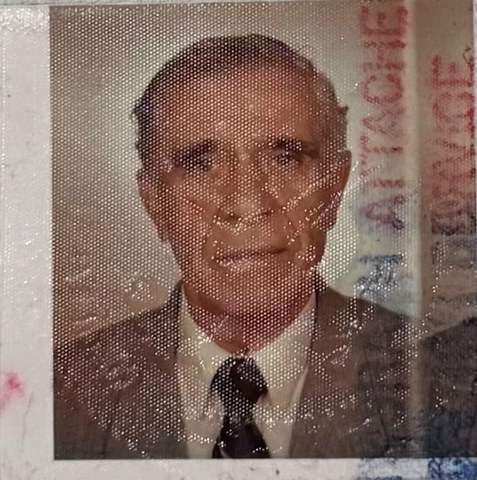
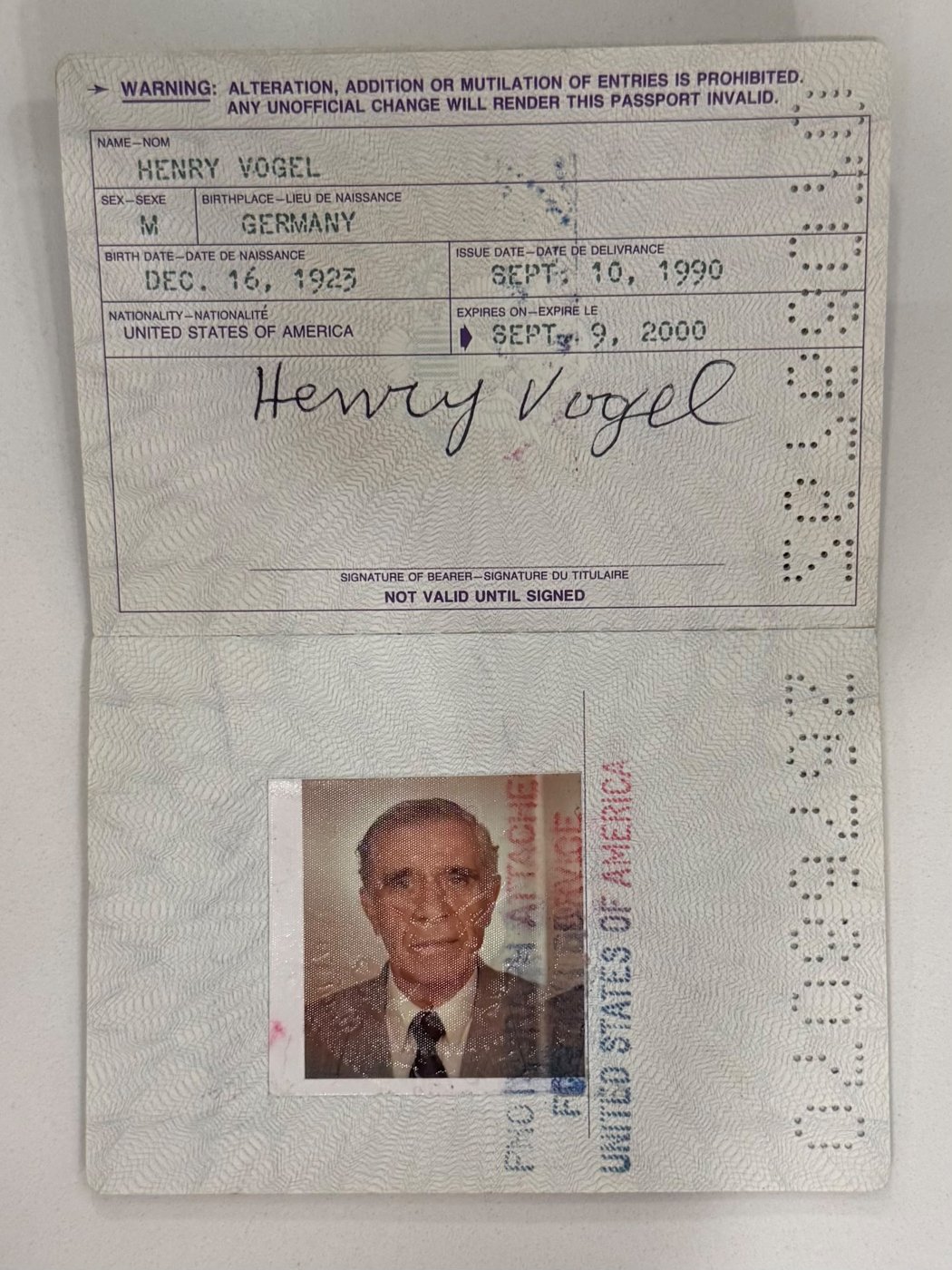
YoungPa’s last passport photo, issued September 10, 1990, weeks before his passing. The passport gives his birth date as Dec. 16, 1923 (family date; he himself said April 1924; archives give 1918) and his birthplace as Germany.The full passport page. Tap to open it full size.
In his emails he calls YoungPa “Dad” or “Chaskel”, and YoungMa “Mom” or “Savta”. His words are kept as he wrote them; […] marks where a passage has been shortened.
Łódź, spring 1938 · Otwock, 1938–39
The two slaps
In the spring of 1938 the Kozhnitzer Rebbe, Reb Aharon Yechiel Hopstein Hy"d, came to Łódź. Young Chaskel pushed his way to the front, and what happened next made him the Rebbe’s chassid for life.
In the spring of 1938, "Chaskel" heard great news, the Holy Admor, Reb Aharon Yechiel Hopshtein, ztzv'kl, was coming to town! Excitement coursed through the warm air! The Heiligeh Rebbe of Kozhnitz, the 7th generation of the Heiligeh Kozhnitzer Maggid, was coming to Lodz to "fiehr ah tisch" (to "lead a table")!
The Rebbe was young, brilliant and enigmatic! A wealthy Chassid invited the Rebbe to his expansive apartment (even the wealthy lived in apartment buildings.)
Chaskel came and saw that the large living room dining room area was packed with Chassidim. When relating this story he would always introduce it by saying, "By then, I already had muscles. The Chassidishe bachurim had to protect ourselves against the Poilisher shgatzim who would attack us. But we didn't have Barbells like you, we had stones. We would start with smaller stones and then bigger and bigger." So he bent down and began to elbow his way through the mob of Chassidim to reach as close to the front as possible, to be able to get near to the Rebbe.
Just as he got closer to the front, suddenly, he felt a sharp "potsch" (slap) on his one cheek, followed by another potsch on his other cheek!! Chaskel's immediate reaction was to clench his fists and begin lifting them to "respond" in kind! ("Ich hab gevalt tzirik geiben!") But he lifted his eyes, stared up and saw "ah zah lichtigeh panim" (such an aura around the person's face) that "I put down my hands and said, to myself, "I don't know who he is, but if he wants to hit me again, let him!"
As he slinked back to the corner of the room, he stood and watched the proceedings. […] Sure enough, it was the Rebbe himself who had the lichtigeh panim, who had administered the "petsch" to Chaskel! […] Soon after, the Rebbe motioned to Chaskel and asked him to come forward. He approached and the Rebbe asked him, "Vee highst du?" (how are you called, ie, what's your name?). He answered, "Ich highss "Chaskel!"
The Rebbe said, "Nu, Chaskel, zitz leyben Mir!" (sit next to me!)
The Rebbe then asked his elder Chassidim on one side to all move down one seat so that Chaskel could sit next to him. What an honor![…]
At the end of the tisch, the Rebbe turned to Chaskel and asked him, "Vest du zayn meine Chussid?" (will you become my follower?)
Chaskel answered, "Yes!"
The Rebbe then said, "If so, please come to me this summer to stay with me in Otvotsk!"
— Rabbi Yisroel Meir Vogel z"l, his son, November 2016
He spent the summers of 1938 and 1939 with the Rebbe in Otwock, the resort town near Warsaw, as his attendant. One memory from those summers puzzled his son for decades:
Some 40-45 years ago, Dad, ע״ה, told me that, when he was in Otvotzk, Poland, the resort town, with the Kohnizner Rebbe, ztzuk”l, in the summers of 5698 & 5699 (1938 & 1939), they would fast with a table laden with delicious foods from before the fast started; and the table was in the Beis HaMedrash!!
I never understood that. […] Afterward, I mentioned something to Reb Shaya about the idea of Hisboddedus.
He responded, “The Kozhnitzer [Maggid] said, ‘You need to be able to do three things […]: (1) גלגול השלג […]; (2) התבודדות while in a hall full of people; & (3) a תענית while a table full of food is set before you!
It seems that the 7th דור, the Kozhnitzer Rebbe, Reb Aharon Yechiel, זצוק״ל, took the Maggid’s vort literally as well. So when they were keeping a required fast (not an extra one), they set the table even before the fast started and fasted with a fully laden table in front of them!
— Rabbi Yisroel Meir Vogel z"l, his son, June 2018
All his life, YoungPa gave the credit for his survival to one thing:
Towards the end of his life, Dad would always subscribe his z'chus of getting out of the Nazi inferno to the "petsch" that he received from the Kozhnitzer Rebbe, ztzukel. I would protest and say, "but, Dad, you had the amazing z'chus of being meshamesh the Rebbe for Two Summers before the war! That was huge!"
He would always ignore that and say, "Nein, Nein! The petsch, the petsch!"
— Rabbi Yisroel Meir Vogel z"l, his son, November 2016
In the ghetto the bread ration shrank to one loaf for a week. YoungPa’s father, Yitzchak Aharon Hy"d, made his own rule for sharing it.
The Nazis set aside a small portion of Lodz to be the first major ghetto, and the first one to be totally closed. In the planning from the end of November, the ghetto was actually closed on May 1, 1940, 8 months after the start of the war. Food in the ghetto was scarce... As the months went by, the food was rationed....one loaf of bread for each person, for Five Days! Then the rations were stretched to one loaf for SEVEN days!
Yitzchok Aharon began making his own rationing: he took his loaf of bread and divided it in four equal parts: one for him and one for each child in his home, Chaskel and his 2 sisters. (Moishe Myer, his eldest son, lived elsewhere in the ghetto, with his wife and family).
Sure enough, as time went on, Chaskel noticed that his father was getting thinner and thinner. He begged his father not to give him his portion but he pooh-poohed it. "Please eat, Chaskel!"
Chaskel also began to fear what would happen to his sister whose health was waning.
Eventually, in March, 1941, he heard that those that would sign up for a work detail would get extra portions. And would be taken away. In that way, he felt hopeful that his father would be able to keep some more of his ration.
He went to sign up, and he was told, "Return in 3 days to start!" He returned home to wait it out and, sadly, in those 3 days, that sister died. (The Lodz ghetto Archives, recorded by the Chevra Kaddisha of Lodz, shows that Fryda Ruchel Rotfogel, born 1917, was buried on 18 March, 1941).
— Rabbi Yisroel Meir Vogel z"l, his son, November 2016
In a labor camp near Poznań in the winter of 1943–44, sick and covered in sores, he was put on a transport “home” to Łódź. He woke up with a feeling he could not explain.
Eventually, the bitter cold and the awful conditions in Poznan took their toll. Chaskel got a scratch on his knee. He could not turn to the Nazis for medical care. Admitting weakness was reason to be removed, to who knew where? […] The cold would not let the skin heal. His skin started to get flaky. Soon the scales had spread all the way up to his face!!
Soon after, Chaskel found out that he was scheduled to go the next day for a two week break to visit his parents on a transport to Lodz!! He was very happy, excited to see his family again for the first time in two years! He told one of his Childhood Cheder friends the good news! His Cheder friend was happy for him but he felt cheated, that he was not going to go with this transport, even though about 2,000 others would be going!
Chaskel went to sleep, dreaming of the unexpected "vacation." However, when he awoke, he had a deep sense of Un-calm.... He turned to his Cheder friend and said, "What should I do? I had a feeling that I shouldn't go this morning!"
His friend said, "Chaskel! What's wrong with you? Don't you want to see your parents?!"
He shuddered, "Of course I want to see my parents, but what can I say? I woke up with a strong feeling that I should not go!" […]
The Shtub-eltster shrugged and said, "First of all, I think that you are meshuga, not wanting to see your parents. But second of all, I don't see that I have a choice! I have a list of numbers and your number is on the list!"
Chaskel was downtrodden. He had no choice!
Suddenly, his Cheder friend jumped up. "Wait, if you don't want to go and Your number is listed, let's switch my number with your number and I will go in your stead! I would love to go!"
At that point, they had not yet been tattooed with numbers on their forearms. They had numbers on their clothing. Chaskel's number patch on his pants and his shirt was "164." They took a chance and Chaskel and his friend switched number-patches and his Cheder friend and 2,000 others were taken for their two week "vacation."
— Rabbi Yisroel Meir Vogel z"l, his son, November 2016
After the war, back in Łódź:
At the end of the war, Chaskel went back to Lodz to see if he could find any relatives. Unfortunately, he did not find any. Suddenly, as he walked through the ravaged streets of Lodz, walking with a few newer friends, someone came from behind, grabbed Chaskel and said to him, shouting, "You were right, Chaskel! You were right!" He turned and saw, it was his old Cheder friend!
"where have you been? What do you mean?"
He answered, "Chaskel, your feeling not to go was SO RIGHT! The Nazis had no intention of letting anyone have a 2 week vacation! One other guy and I were separated from the crowd of the sickly and they took the 2,000 remaining and shot them!"
Most probably, since you were obviously sickly, you, too, would have been shot! When they saw me, they probably assumed that I had healed, so they saved me for more work. But you, had you stayed? Oy!"
— Rabbi Yisroel Meir Vogel z"l, his son, November 2016
Even in the camps he kept making jokes, and kept others laughing. Then a summer in the potato fields gave him back the strength he would need for what came next.
In the winter of 1943-44, he spent time in the work camp on a mountain near/in Poszan. He would work in the mountains, digging out mining material. Spending day after day in the dark, cold mountain, he thought of the idea to ask the Nazi "taskmaster" to tell him what was the "maskoynes ha'levynim" (the quota of bricks […]: how much material did they expect the Jews to mine in a day)? The Nazi answered him, and Chaskel asked if they could hurry up and do that amount faster, but then rest in the waning hour in the warm sun on the mountainside. He got permission!!
He would sit and sunbathe of sorts, and "make vitzin" (make jokes, puns). Other Jewish captives asked him, "Chaskel! How can you make vitzin??"
He answered, "If we stop making vitzin, then "they" have won!"
This was one way to maintain their humanity, a way to stand strong and not give in to defeat.
Another time for a "vitz," was when they would whisper while marching in formation: the Nazis would shout, "Linx! (Left!) Linx! Linx und Linx!" They would defiantly whisper a slightly different "nusach:" "Linx! Linx! Vehn Der Hauptmann camt....shtinx!" (When the Overman, the Leader, comes, it stinks!")
(Many times, the Jews would strengthen their resolve to live by saying, "Mir vellen zey iber-leyben!" (we will outlive them!)
— Rabbi Yisroel Meir Vogel z"l, his son, November 2016
Then came the potato fields:
In the meantime, Chaskel was soon after called to the neighboring valley, to work the fields. In that spring & summer, he and his barrack mates were picking potatoes for the German soldiers' war effort. It was heavy work, but they spent the entire daytimes basking in the warm and healing sun. In addition, they were able to do some "organizeerung." Organizing meant that the each inmate would take a chance on a different day. They would tie the bottom of their pant-leg to allow them to throw down a potato for each one of their "organization" and they would each get an extra potato each day! […]
What happened when he was caught with the organazeering? The Nazis contained the whole group overnight and intended to hang them in the morning. Chaskel said, "We have to beg for our lives!" Others said, "No, there is no point!" Chaskel persevered and somehow, went before the Kommandant and said, "Mir habben gevein hingerick!" (We were hungry!) The Kommandant waved his hands at them and threw them out of his office!.....and they lived to see another day!
Because of the change of venue from in the mountain to out in the sun and because of the great improvement in food during the summer of 1944, Chaskel became appreciably healthier. This was especially fortuitous as his next destination was Birkenau section of Aushwitz. Chaskel would say that the potatoes strengthened him enough to make it through to the end of the war!
— Rabbi Yisroel Meir Vogel z"l, his son, November 2016
In January 1945 the SS drove the prisoners west on a death march. YoungPa ran into a forest, and a few weeks later found himself hosting a victory party for the Russian army.
Dad saw that there was no choice! His strength was waning. The SS had no patience for anyone who tripped. He decided that he had to make a move. That night, as the Death March was passing a forest, he joined 3 French prisoners of war and ran into the forest. For the next few days, while on the run, the French soldiers introduced Dad to French cuisine. They captured rabbits and frogs and prepared them to eat. Dad said, "the rabbits tasted like chicken, but I couldn't eat the frogs. Ugh!
— Rabbi Yisroel Meir Vogel z"l, his son, December 2016
After a while, the four escapees found a nearby German town and decided to part ways. Dad approached a local butcher shop and asked for lodging. The butcher took him in for the night. The next morning, the owner of the shop took him out to a large field and engaged Dad in a conversation. […] Timidly, he asked, "Du bist eine Jude?" "You are a Jew?"
Dad responded, "Ja! Ich bin eine Jude." "Yes! I am a Jew.... And when the Russians come, as you know, they are coming soon, I will save you! You will be able to prove that you were not a Nazi sympathizer because you are harboring a Jew in your home!"
The butcher took him back and allowed him to stay in the home, which was situated above the storefront on ground level. At this point, I think he also gave him a German name, picking "Heinrich" because of its similarity to "Chaskel." (Or, Dad chose it for himself. Does anyone know?)
Sometime later, Heinrich happened to be upstairs. Suddenly, the boss came upstairs and, frantically called him, "Heinrich! The Russian Army is in town! A group of soldiers are here!" Heinrich rushed downstairs. A group of Russian soldiers were at the door, ready to trash the store and get food.
Heinrich immediately took control of the situation: he told the soldiers that he was a Jew, and that he was staying with this butcher's family. He then handed them a whole liverwurst, which he suggested they take to assuage their hunger. "Here! Please take this for now!" […] Then he told them "I will prepare a proper meal for you right here. You should come back later this evening and we will celebrate the victory over the Nazis!"
The feast was prepared! The German butcher and his family crept upstairs and hid in fear. Heinrich waited in the store, expectantly. […]
They all passed around the salamis and wursts and broke out drinks from their packs! Everyone was poured a large amount of Russian Vodka, including Heinrich! They all lifted their cups and cried out, "Skol!!" […]
Heinrich joined in in this initial "toast" to the victory over the accursed Nazis! But his mind began to race for a solution as they began, once more, to pass around drinks […]. "What shall I do?" he pondered? "I haven't eaten well for many moons! I cannot drink too much! If I do, it could kill my damaged system, which has yet to recuperate. But if I don't drink with these soldiers, they may doubt my happiness over their victory! Who knows what old AntiSemitic angers may flare?!"
Thinking quickly, as they refilled everyone's cups, they all lifted their Vodka and cried out "Skol! To us! Skol! To the Victory! Skol to the generals! Skol to Stalin!" Each time they poured and lifted their beards to guzzle down the vodka, all that is, but Heinrich....he lifted the glass, said, "Skol!" Leaned back, put the glass towards his lips and...quickly, when everyone looked to the ceiling to finish their drinks, he moved the glass alongside his face and emptied the contents...on the wall behind him!!
By the end of the night, all the Russian soldiers were dead drunk, Chaskel was the only one still sober, while the wall behind him was soaking wet!
— Rabbi Yisroel Meir Vogel z"l, his son, April 2017
After the war he went back to Łódź and found no one. When Poles murdered some 42 Jewish survivors in Kielce in July 1946, he decided he was done with Poland, and took the Taube family with him.
As I said, Dad was working hard to establish a new life for himself. The postwar period was very unsettled. There were great difficulties in obtaining certain things. And the list of those things were different in different countries. Dad, AH, determined which of those things he could get a hold of from Poland and Germany and deliver surreptitiously to customers from the other country. He began to be rather successful. (This is called "the Black Market." I am NOT suggesting to anyone that this is a good way of making Parnossah! 😖)
By early 1946, it seems Dad was doing pretty well. However, on July 4, 1946, a terrible event occurred. Polish soldiers, police and civilians attacked the Jews of Kielce Poland, murdering 38-42 Jews, all Holocaust survivors! […]
Dad was one who decided, in his words, "That's it! Poland is finished for me." Herman Taube was considering waiting it out, hoping cooler heads would prevail. Dad said he has had it and he was leaving. I don't know for certain, but I think that he offered Herman to help out in getting his family to America. […] In any event, he and Herman and family ultimately went to America in Spring, 1947, on the SS Ernie Pyle.
When he came to New York, there were no welfare programs. One had to come with a minimum of money per person. Then one needed to work. Dad got a job in [Manhattan?], New York at a clothing factory. He sat at a sewing machine and worked in tough conditions for $14.23 per week(!)
Frustrated at this "dead end" job, he went to HIAS (the Hebrew Immigrant Aid Society) and said, "Send me to the nearest Jewish community outside of NewYork!" For some reason, HIAS skipped Philadelphia, and sent him to Baltimore. (I guess it was bashert that he needed to meet Mom!)
— Rabbi Yisroel Meir Vogel z"l, his son, December 2016
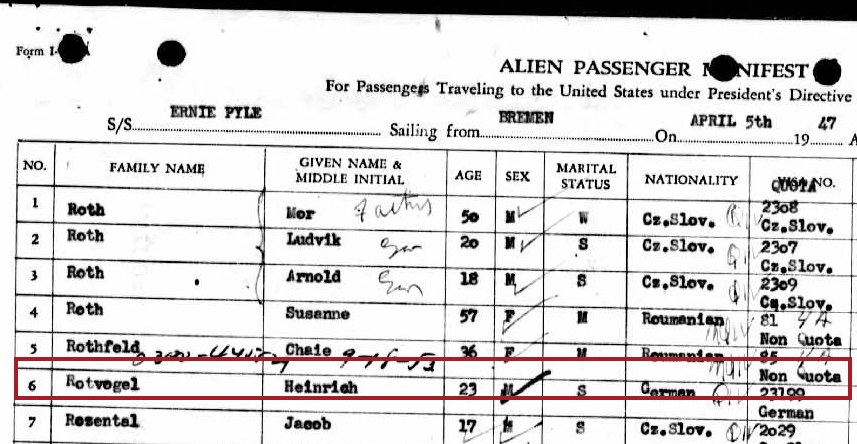
A year later his son found the ship’s passenger list, with YoungPa on it as “Heinrich”:
He is called “German” because his mother came from the Polish-German border. He said that he came from Labas, Germany, because he knew that there was no way that a Polish citizen would get to immigrate to America in 1947 […]. After losing his whole family and the Kielce Massacre […], he said, !פוילין איז גע׳ענדיקט פאר מיר “Poland is finished for me!” And he made it his business to leave!
— Rabbi Yisroel Meir Vogel z"l, his son, December 2017The SS Ernie Pyle passenger list, sailing from Bremen on April 5, 1947 and arriving in New York on April 18. Line 6, outlined in red, is YoungPa, listed as Heinrich, age 23. Found by his son through the Joint Distribution Committee. Tap to enlarge.
HIAS sent him to Baltimore around the Yamim Tovim of 1947. He spoke no English and had no money, but he knew his father’s trade, and one shochet was willing to take a chance on him.
He came to Baltimore sometime around the Yamim Tovim of 1947. He immediately searched for a shocheit who would agree to slaughter chickens for him. He met with a great deal of resistance. Many were afraid to be accused of helping competition of their old and reliable customers. "Who do you think you are?"
He responded, "My father was in this business. He sold geese and chickens in Lodz! I helped him. I want to continue the family business!" At least one person answered him, "Well, then go back to Lodz!"
One man, however, listened to his plea. Rabbi Moshe Yudkiwsky, a Talmud of Yeshivas in Europe and Eretz Yisroel who came to America before the war, decide to help out this "greener." He shechted 5 chickens for him on credit!
Dad was determined. He took a [burlap?] bag and filled it with the kosher chickens and went on his way. […]
Dad could not yet speak any English. So he took his bag of chickens, walked along the streets of Garrison Park and looked for any house that had a mezuzah on the front door. He knocked and, in Yiddish, he asked if the balabuste might need a chicken for Shabbos?
After some time, he sold all five chickens! Happily, he went back to Rabbi Yudkowsky, paid him, and asked him to schecht 5 more. After a long, full day, of close to 20 hours, he succeeded in selling enough chickens to make a profit of $28, double a week's pay at the sewing machine in ny!!
He was so thankful! He had no one to dance with so he did a jig by himself, celebrating his success!
Over the next few months, he continued walking the streets of Garrison Park, bag over shoulder, selling chickens on Monday for "Der Voch" (the week) and on Thursday for "Shabbes."
One day, a sensitive child, noticed Mr. Vogel strutting through the streets with his bag of chickens. Mr. Vogel was sweating a great deal in the hot sun. This child, Moshe, was the son of a European Rav, rabbi Leopold Fischer […]. He wondered if he could help this hardworking man. He had a special toy, a fancy & sturdy toy wagon. It was called a "Red Flyer." It was made of strong steel and had wood walls around the back. (Similar models are still sold today!)
He went over to Dad and asked him, "Mr. Vogel, would you like to borrow my wagon?"
Thankfully, Dad took the wagon and was able to double the amount of chickens that he could transport from Rabbi Yudkowsky to go through the community. Because of this kind child, Dad was able to significantly increase his business. Soon thereafter, he was able to buy a truck […] then, he returned the Red Flyer to Moshe.
— Rabbi Yisroel Meir Vogel z"l, his son, December 2016
He never forgot either of them. Decades later:
One Shabbos, we went to shul and Rabbi Fischer introduced dad to one of his children. That child, then a tall, impressive NY lawyer, shook hands and both said, Gut Shabbos. My father turned to me. In front of Mr Fischer and said, "Remember the story I told you about the boy who lent me the Red Flyer?" as Mr Fischer smiled from ear to ear. "Here he is!"
[…] After shul, he introduced me to the Rabbi. "Here is my shochet that I told you about!" This was said with great excitement, even though Dad had sold the chicken business some 25 years before!
As usual, he offered the Rabbi a ride home. […] When Rabbi Yudkowsky, who was a very short man, approached the truck, he turned to Dad and politely said, "Mr. Vogel, I can't get up that step. It's ok. I can walk home. It's not so far!" Dad responded in a pleading voice, "Please, Rabbi Yudkowsky, let me help you up! Excuse me, but please hold your Tallis bag like this." […] The rabbi listened, and then Dad went behind him, lifted him up gently by putting his hands under the rabbi's elbows, and lifted him straight in to the truck cab!
— Rabbi Yisroel Meir Vogel z"l, his son, December 2016
“When you do something, do it right!” was YoungPa’s own motto. Some of these stories his son only heard years later, from other people: “He was not one to sing his own praises.”
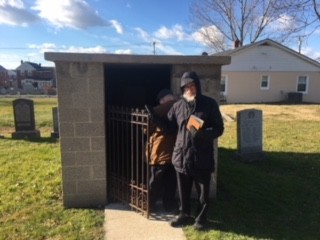
Today is 7 Teves, the 54th Yahrzeit of Rebbetzin Fayga Yitta Taub, the mother of the Rebbe, Rabbi Taub. He asked me to come to the Cemetary to make a minyan at the Ohel. In discussing the trip to the Ohel, he commented, “You know that your father, Reb Chaskel, built the Ohel for my mother?”
I actually had had no recollection of that. I did remember that Dad, ע״ה, took care of the Ohel Yakov congregation Cemetery shortly before I turned bar mitzvah. He became aware that many מצבות were in bad shape and needed foundation work to stop them from falling over, etc. I remember that he did that work for weeks (or more?) with his non-Jewish worker. Ohel Yaakov Congregation was so thankful for his work (evidently it was for free) that they made him Vice President of the shul as a “thank you.”
But this was about 2-3 years before that. She passed away tragically, at the age of just 38 years old, on 23 December, 1963. The Ohel was then built some time in 1964. I was just ten years old at the time. Rabbi Amram Taub, זצוק״ל, wanted her to have a full Ohel over the grave, in case anyone else nearby was not properly shomer Torah u’Mitzvos. Dad decided to do the job. It is a simple structure, a bit more than 7’ wide and 13’ long, with a gate and with one interesting feature that the מצבה is imbedded in the wall of the structure.
It was gratifying to see that the structure was in almost perfect shape over half a century after it was constructed!
“When you do something, do it right!”
PS. […] There was a shul meeting and the topic of discussion was the renewal of the Rabbi’s one year contract. This was the first time that my father had heard of a rabbi getting only a one year contract. He was shocked! He stood up and said, “This is not כבוד for a Rav to have just a one year contract. He should have a life-time contract!” He stood at the helm and basically dared anyone to disagree. No one did, so the Rav, Rabbi Benyamin Moshe Dinovitz, ז״ל, got a lifetime contract!
Then, someone turned to Dad and said, “Well, since you showed such leadership, maybe you would like to be the president of the shul?” Dad answered, “No, that’s alright! The Rabbi has a proper contract now. I did my mitzvah! I can resign now!”
[…] I never heard Dad talk about either of these stories. He was not one to sing his own praises....
— Rabbi Yisroel Meir Vogel z"l, his son, December 2017The ohel YoungPa built in 1964 for Rebbetzin Fayga Yitta Taub, still standing on her yahrzeit in December 2017.
The same care went into the beis medrash he gave to Baltimore:
This morning, I was zocheh to lead the davening at the Amud in the RothVogel-Kozhnitz Bais HaMedrash of the Agudah of Baltimore. It was dedicated in the early 80s (1983?) by Dad, A"H, and, l'hibadel Mei'Chaim l'chaim, by Mom (Savta). For a long time, it was the only Bais HaMedrash in town that was used for Ba'alei Batim and at times even for an afternoon Rebbe-Kollel.
It is still used for Torah and Tefillah every day by tens if not hundreds of people. It was dedicated to the memory of his parents, of blessed memory, R' Yitzchok Aharon and Sarah Rothvogel, and his Rebbe, Admor Aharon Yechiel Hopshtayn, ZTzuK"L.
[By the time of his petirah, he had paid off only part of the pledge. After negotiations with Rav Shmuel Kamenetsky, all five of us, his sons, agreed to to complete the payment of the pledge from part of his inheritance and to rededicate it to his memory as well. […]]
— Rabbi Yisroel Meir Vogel z"l, his son, December 2016
YoungMa, Etta Rea Vogel ע״ה, was born in Baltimore on March 30, 1929, the daughter of Isadore z"l and Freda Fishbein ע״ה. Her son wrote about her side of the family too: her father the master tailor, the name she was given, and a Chief Rabbi of Paris.
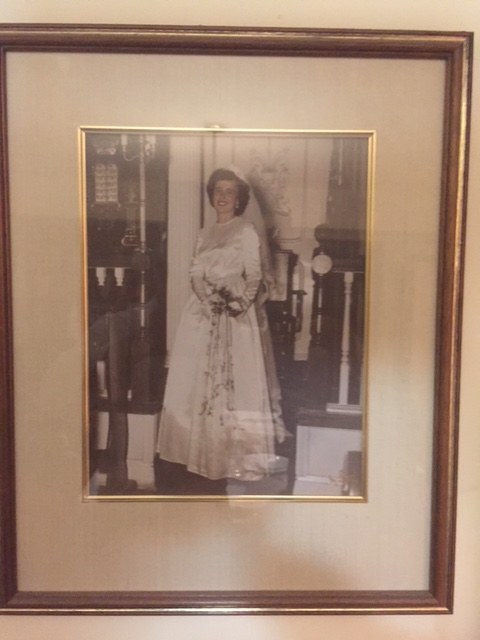
Zaidy started in America as a tailor. He eventually became very sophisticated in his skills. He then was named a Master Tailor. One of his stunning works was the Wedding Dress that he designed and created for Savta, which she wore at her wedding.
However, he did not satisfy himself by merely a good worker or even an excellent craftsman. He studied in a Yeshiva in Poland until about 17. He became fluent in Hebrew. He was a subscriber for many years for HaAretz, a very sophisticated Hebrew journal.
He also was a self taught scholar in English studies (and spoke with no accent). He bought an Encyclopedia Britannica […]. He took this seriously. […] He became very proficient in English. And was self taught in many other subjects.
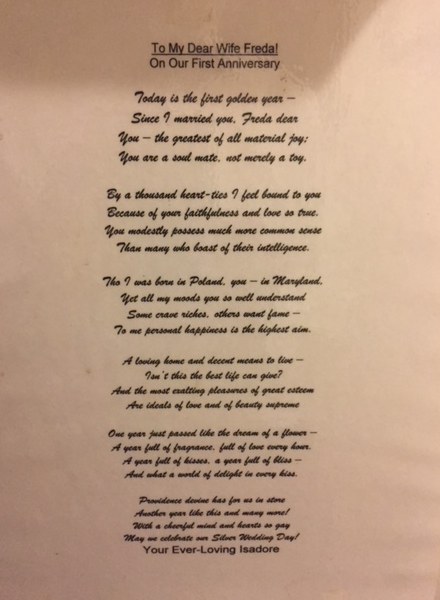
In January, 1929, he wrote the following original poem in honor of his and Bubby’s first anniversary. (It was written shortly before the birth of Savta, 3 months later.)
— Rabbi Yisroel Meir Vogel z"l, his son, July 2018
YoungMa in the wedding dress her father designed and made. She married YoungPa on August 14, 1949.Isadore’s poem for Freda on their first anniversary, January 1929.
Read the poem
To My Dear Wife Freda! On Our First Anniversary
Today is the first golden year — Since I married you, Freda dear You — the greatest of all material joy; You are a soul mate, not merely a toy.
By a thousand heart-ties I feel bound to you Because of your faithfulness and love so true. You modestly possess much more common sense Than many who boast of their intelligence.
Tho' I was born in Poland, you — in Maryland, Yet all my moods you so well understand Some crave riches, others want fame — To me personal happiness is the highest aim.
A loving home and decent means to live — Isn't this the best life can give? And the most exalting pleasures of great esteem Are ideals of love and of beauty supreme
One year just passed like the dream of a flower — A year full of fragrance, full of love every hour. A year full of kisses, a year full of bliss — And what a world of delight in every kiss.
Providence divine has for us in store Another year like this and many more! With a cheerful mind and hearts so gay May we celebrate our Silver Wedding Day! Your Ever-Loving Isadore
— Isadore Fishbein z"l, January 1929
Her name was a promise kept to her great-grandmother:
On March 30, 1929/18 Adar 2 5689, she gave birth to Etta Rea (Etta Rachel). Her daughter was named after her maternal grandmother, Etta Levin, the mother of Leah Devorah. Etta Levin had told her children, "after I pass away, do not name a child with a similar English name, such as Ethel or Edna, only the Yiddishe name, Etta!"
Therefore, to respect her grandmother, the parents did not follow the prevalent "custom" of giving a common American name as a legal name with the same sound or initial as the Yiddishe name: "only the Yiddishe name, Etta!"
— Rabbi Yisroel Meir Vogel z"l, his son, June 2016
And through Isadore’s aunt, the family had a cousin who became Chief Rabbi of Paris, Henri Leon Champagne z"l:
Sara Mintzl Fishbein married Itzhak (Yitzchok) Champagne in Warsaw, in the 1890’s. Their son, Haim Leib, was born there on April 21, 1898/29 Nissan, 5658.
He was a first cousin to our Zaidy, Yitzchak Hirsch, who was 3 1/2 years old at the time of Haim Leib’s birth. Years later, Zaidy Yitzchak Hirsch anglicized his name to “Isadore Harry” Fishbein when he moved to the USA. Similarly, after the Champagne family moved to Paris, France in 1900, at some point, Haim Leib name was francisized (yes, that is a n actual word! 🤓) to “Henri Leon” Champagne.
In 1916, at about 18 years old, he enrolled as a student at the Rabbinical Seminary of Paris. […] He became a Rabbi in Paris in 1936 and finally, he was appointed as “Grand Rabin” [Fr. “Chief Rabbi”] at the Main Synagogue of Paris in 1938.
When the Nazis took over Vichy, France, Grand Rabbi Champagne became a military Rabbi for the troops to serve them as they were fighting against the Nazis. In March, 1946, in recognition of his important work as a military Chaplain, Rabbi Champagne received the high honor of being inducted to the French Legion of Honor!
After the liberation, he resumed his post as “Grand Rabin” at the Main Synagogue which he filled honorably until his unfortunate premature death at age 50 on Shabbos, August 28, 1948/ 23rd Av, 5708.
— Rabbi Yisroel Meir Vogel z"l, his son, August 2018
In 2014 his son searched the Łódź Ghetto archives and found family nobody had known about: YoungPa’s uncle Nachman Hy"d with his wife and four children, and his uncle Reuven, two of whose sons survived the war.
As you know, I have found some of the dates of family yahrzeits on the Lodz Ghetto Archives.
Six Rotfogel family members, from the same apartment, were taken to Chelmno […], then a death camp, on March 16th, 1942.
The Hebrew date was 27 Adar, 5702 […]. Their names were (1) Nachman (ben Layzer?), 45, born 1897, 15 years after Yitzchok Aharon's birth; (2) His wife, Leah, 40, born 1902; And his four children: (3) Shlomo Laib ben Nachman, almost 15, born 10 April, '27; (4) Hendl Chaya bas Nachman, 10, born 1st Jan´32; (5) Vita (Chaya?) bas Nachman, 9, born 16 Jan, '33; (6) Noson David ben Nachman, just over 2 1/2 yrs, born 6 Aug, ´39, a month before World War II started.
Tihyena nafshosayhen tzruros bitzror haChaim!
It's interesting that I found out that Ryven (Chassidishe way of saying Reuven), who was 13 yrs younger than Yitzchok Aharon and 2 yrs older than Nachman, lived until the last months of the war. He was niftar 9 Jan, '45, about the time of the death march that Dad, Alov ha'Shalom, escaped from.
Two of his children, assumedly Dad's first cousins, SURVIVED THE WAR! His older child, Yosef Moshe, who was born 15 Feb,'25, LIVED UNTIL 2004! Sadly, we never connected with him...
Ryven had a second son, Eliezer David, born 17 February, 1927, according to the Lodz Ghetto Archives, who also survived. Unfortunately, he was niftar young at 30, that is 1957. […]
May all of them be meilitzei yosher for us (those who express our yashrus ... our good points) ... to Hakadosh, Baruch Hu.
— Rabbi Yisroel Meir Vogel z"l, his son, March 2014
The Rotfogels sold kosher poultry in Łódź. What young Chaskel learned in that shop he used again, ten years later, on the streets of Baltimore.
The Rotfogels, Kinsker Chassidim, had a storefront business selling kosher fowl for Shabbos and the week. (Interestingly, Yechezkel said that the wealthy people would buy geese lichvod Shabbos Kodesh. Chickens would be bought only by the less fortunate.) Yitzchak Aharon would sit in the back of the store and learn Gemara while Sarah would mind the store, except on Fridays and during busy hours, when she would call her husband up front.
Occasionally, they would notice a "Shylah," a question of the Kashrus of one of the fowl. Yitzchak Aharon would call Yechezkel over to bring the "Shylah" to a Moreh Hora'ah, a Rav who would pasken the Shylah. (This experience came in handy many years later when Yechezkel sold chickens in Baltimore!) Also, when they would have leftovers, when Shabbos approached, Yechezkel would sometimes take them by his father's request, and distribute them to poor Jews who could not afford even chicken lichvod Shabbos Kodesh.
— Rabbi Yisroel Meir Vogel z"l, his son, November 2016
YoungPa was proud of his mother, Sarah Hy"d. For Rosh Hashanah 1939, days after the Germans took Łódź, she had made him a new silk coat.
Many bachurim began running to the fields, to escape to the forests surrounding Lodz. Yechezkel, too, joined the crowd, many dressed in their Yomtov finery. Yechezkel's mother, Sarah Rothfogel, was a woman of many talents. She was an accomplished seamstress, who made beautiful dresses for Yechezkel's two sisters, Fayga Ruchel and Tzirka. For that Yomtov, Sarah had made Yechezkel a beautiful "zaddeneh ibettzeh" (a silk beckesheh).
Suddenly, as he and others were crossing the field, the Luftwaffe flew overhead and began strafing (attacking with machine guns from low-flying aircraft)! People started dropping onto the fields to avoid being hit. He was forced to the ground, ruining his beautiful ibbitzeh with the fertilizers which had been spread on the fields....a sad memory....
— Rabbi Yisroel Meir Vogel z"l, his son, November 2016
Yitzchak Aharon Hy"d tried everything to stay out of the army. It explains a long gap between his children that his grandson only noticed years later.
It seems that he had managed to get an exemption because he had a hole in his eardrum, so, obviously, he couldn't be on the field of war, being unable to hear a sergeant's commands from one side of the field. However, the reason that he had that exemption was that he took a grave chance and had a kind Jewish Doctor surreptitiously pierce his eardrum in order to give him a reason to be exempted. It worked! Unfortunately, shortly thereafter, he was called in to the Army anyway. It seems that someone was able to find out about the secret "operation." and was "moiser" Yitzchak Aharon to the authorities.
He was forced to go to the army anyway and did KP duty, if I understood correctly, for a full five years!!
Now this story was common knowledge in our family. However, I do recall that once, my father threw in a line in response to something else, as if I/we knew it already, "well, you know that my father was away from the family for 5 years, so that is why there was such a big space between my brother Moshe Mayer and my sister Fryda Ruchel!"
— Rabbi Yisroel Meir Vogel z"l, his son, June 2013
After the war YoungPa went back to Łódź hoping to find his sister Fryda Ruchel Hy"d. This is the story, as his son wrote it down in 2013, of what a man there told him.
[…] my father never imagined even looking for his brother, because, as he often said, "My brother, Moishe My-er, was a Yeshiva bochur and very frail. I was sure that he didn't 'make it.' My sister Tzirel died before I left to workcamps." […]
I went to Lodz after the war to look for Fryda Ruchel, because she was healthy and sturdy and I had hope that she would be alive. When I came, I met a man who told me that she was in front of him in the line as they entered Aushwitz/Birkenau complex and Dr. Mengele, the "malach ha-muvess," at the entrance of the camp, where it said "Arbeit macht Frie" "Work makes (one) free," would point with his finger: "Right!" directing that person to the right, for a few days more of deprivation, etc. and "Left!" and that person would go to the concentration camp ovens, Lo aleinu!
The man said, He said "Left!" She ignored him, told herself, "avu der mama gayt, gaye ich oichet!" Where the Mother goes, I go also! […]
— Rabbi Yisroel Meir Vogel z"l, his son, June 2013
A note on this story: Family records and his own later emails show Fryda Hy"d died in the Łódź ghetto in March 1941, and Tzirel Hy"d was deported to Chełmno with their parents in 1942; the story as told may belong to another moment.
Great-grandfather Lejzer and the name Eliezer Baruch
When his own son Eliezer was born, Rabbi Vogel called YoungPa’s cousin Rivkah, who had left for Eretz Yisroel just before the war, to be sure of his great-grandfather’s name.
Then after Eliezer's birth, she became very animated in her discussion. She assured me that his name was "Laizer!" (nickname for Eliezer). She then began a mini hesped about him. "Doda" Rivkah said that he was a Ben Torah, that he was "ahuv laMakom v'ahuv laBrios," and, among other things, that he, too, was killed during the War. (I had always had the impression that he had died before the war.) It is because of the last comment that I added "Baruch" to Eliezer's name.
Years later, I found documentation (from the Lodz Chevra Kaddisha online, on the website "jewishgen") that Layzer had passed away in 1928. I realized that she was most probably talking about her uncle, Itzik Aron. […]
— Rabbi Yisroel Meir Vogel z"l, his son, June 2017
YoungPa was not the only Baltimore Jew with a story about the Kozhnitzer Rebbe. When he met another, he made sure his son heard it first-hand.
When I was learning in Lakewood Yeshiva, I once received an excited call from Dad. “I would like you to come home for Shabbos! There is another Yid here for a short time in Baltimore who met the Rebbe and also has a story!” So I asked to hear the story…
“No!” said Dad. “I want you to hear it from his mouth!” […]
“Well, I was a young bachur in Warsaw in the early 1930s. I was walking to the Great Shul in Warsaw, going downstairs to the mikveh before davening. […] I was on the top few steps and as I descended, I heard someone behind me. I turned around and noticed the Rebbe walking with a Gabbai at his side. Suddenly, he leaned down and pushed me on my shoulder! I went down the steps, my hands this way and my feet that way, until I reached the bottom of the long row of steps! The Rebbe continued walking down the steps in a slow, regal walk. As I began to regain my bearings, he reached me and leaned over and tapped me on my shoulder and said, “Du vest leyben ah langeh, gezundteh leyben!! (You will live a long, healthy life!”)
He then added, “I am here from Eretz Yisroel because my wife needs tipulim (treatments). Since that day, I have never been sick one day in my life!”
— Rabbi Yisroel Meir Vogel z"l, his son, November 2016
Selling chickens door to door in Baltimore, YoungPa sometimes spotted a possible halachic problem in a bird, the way he had as a boy in Łódź.
A decade later, Chaskel would need that "shimush" again when he began selling chickens on his own. Occasionally, after Rabbi Yudkowsky shechted the chickens for him, he would notice potential Halachic problems while on the streets of Baltimore. He would put aside the chicken and find a Rabbi to pasken (decide) whether the chicken was kosher or traif. Sometimes, when he approached a young Rav, the Rav would ask him what he was concerned about. When he answered, the Rabbi would ask him again to point out the issue. He commented, "oh! That is what it meant in the sefarim!" He had had the book knowledge but not the shimush! Dad had the shimush but not the book knowledge. Together, they came to a proper conclusion.
— Rabbi Yisroel Meir Vogel z"l, his son, June 2017
By then he had a truck and a line of regular customers on the corner. He promised every one of them a full refund if they didn’t like his chicken.
One day, a new woman approached and asked to buy a chicken. As always, Dad assured her that his chicken was freshly bought and freshly shechted. He reiterated his guarantee, "If you don't like it, you may bring it back for a full refund!" The young lady bought the chicken, he thanked her, and she went home with her new purchase.
The next week, as the women lined up on the corner where Dad had parked, the new lady joined the others. But she was not interested in buying more chicken. She complained to Dad, "The chicken which you sold me was not good! I cooked it but it smelled terrible! We couldn't possibly eat it!"
Dad was puzzled. How could that be? (It certainly was poor publicity, in front of his other seasoned customers!) He asked the young lady to please bring the chicken to him. "As I said, I will give you a full guarantee, but please let me see the chicken." The young lady quickly brought it to him. It did, in fact, smell bad! Dad looked carefully and saw that all the innards were still there! The young lady was a new bride. This was the first raw chicken that she had ever prepared! She didn't know to de-bowel the chicken (to remove the innards).
Now he understood what the problem was, technically, he had no reason to honor his guarantee. What should he do? […] He explained to her: "My chicken was good but you didn't realize that you needed to remove those innards! I will honor my guarantee anyway, but come let me show you what to do!"
Dad lost a few dollars by giving a chicken for a guarantee that he technically did not need to honor. Yet with that small value, he gained a satisfied customer who returned again and again!
— Rabbi Yisroel Meir Vogel z"l, his son, June 2017
In 2018 a family photo from 52 years earlier arrived by email.
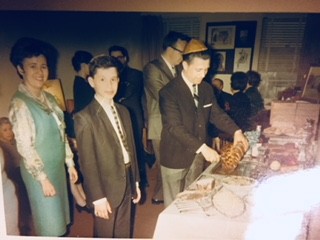
YoungPa cutting the challah at a family bris on March 20, 1966.
My father, Uncle Henry (Yechezkel, ע״ה), was asked to cut the Challah after the bris of Davis Soffer, […] as Aunt Etta and Cousin Yisroel Meir (aged 12 1/4) look on.
— Rabbi Yisroel Meir Vogel z"l, his son, February 2018
YoungMa’s mother, Freda Fishbein ע״ה, was tone-deaf, and determined that her daughters would not be.
FRAYDA Chana was always intrigued with music, even though she was tone-deaf. She wanted her children to enjoy music too. So she thought, how can I help them not to be tone-deaf?" She came up with a very forward thinking idea, later called the Suzuki method. She played records of classical and contemporary music throughout her pregnancies. And both her daughter's became very musical, both singers and piano players!
She was very supportive of her husband, Zaidy Isadore, who had moments of difficulty overcoming sadness. She would talk things out with him and wrote over his feelings in a book to "get it out" of his system. […]
Her mother eventually became infirm and Freda took her into her small home and cared for her until the end of her life. Years later, she was zochah to the same paradigm, as her daughter, Savta Vogel, took her into her condominium/apartment for years and cared for her.
— Rabbi Yisroel Meir Vogel z"l, his son, June 2016
American Jews were far from the war, but YoungMa met its hatred as a girl in Baltimore.
Anyway, in the early 30's, when Hitler, yemach sh'mo v'zichro, was elected, there were many German Americans who were very proud of the strength he showed. Some were even open about their happiness with his anti-Semitic policies, as well. One such family was Savta's neighbors!
[…] the next door neighbor was a "proud German" and drew two lines on the sidewalk, on either side of his house. Then told Savta that she wasn't allowed to walk on their "German" territory...so she had to walk in the gutter, if she went that direction.
That all changed on Dec 7, 1941. (Pearl Harbor) All of a sudden, the lines disappeared and they were "loyal Americans!"
— Rabbi Yisroel Meir Vogel z"l, his son, April 2017
Isadore Fishbein z"l told his grandson this parable more than once, to encourage him to keep improving.
Once there was a young Prince who was hunchbacked. He wanted very much to be able to stand up straight but as much as he tried he was unable to stand up straight at once.
His father, The King, had compassion on him and decided to help him out. He made a beautiful statue that was the exact likeness of his son, the young Prince. But there was one difference: the statue depicted the young Prince as if he was standing perfectly erect!
The King brought the statue to his son, the young Prince, and gently gave him instructions: “My dear son, every morning, after you rise and are prepared to start your day, stand next to the statue. Try your best to stand just a little bit straighter each day....Little by little, you will improve as best you can!”
And so, the young Prince followed the instructions of his father, the King. In the beginning, despite the Prince’s daily efforts, it was difficult to see any difference. Slowly but surely, he began to “straighten up” more and more. Eventually, he was able to stand next to the statue and they actually looked as if they were twins! The Prince was no longer hunchbacked!
Zaidy gave over this moshal several times to encourage me to try to improve myself. […] The nimshal is: the King is HaShem. The Prince is each one of us. The hunchbacked status is our difficulties. The “statue” is the Torah & good middos that shows us how we should look […]
— Rabbi Yisroel Meir Vogel z"l, his son, July 2018
The family keeps December 16, 1923 as YoungPa’s birthday (family date; he himself said April 1924; archives give 1918). In 2013 his son wrote down what YoungPa had told him about it.
[…] she had heard that my father, Alav haShalom, was really 6 years older than he actually wrote on his passport. I quite sure that this is an error. I heard from my father that he was 6 months younger [as I recall, he was born in April, 1924, in Lodz, but picked Dec. 16, 1923, although that is 5 months] than his papers stated because he wanted to be able to a) be free of the Polish draft because b) he had had enough of war and c) when he heard about the Kielce massacre […] he said "I am finished with Poland" and told Herman and Susie Taube "Let's go to America."
— Rabbi Yisroel Meir Vogel z"l, his son, June 2013
His emails end with outlines of stories he meant to write next. Some of the titles:
The rebbe helps out an Almanah...(great story!) · A summer rain...(a Rebbeshe mofeis!) · A ta'anis in the presence of the Rebbe...
Windows & Brushes · Shabbos and a brand new bicycle · Walking to shul. · The Bais haKevoros of Ohel Yakov · Vice President; Lifetime contract for the Rav: Respect! · President? No! · Another move · Coming back from Eretz Yisroel · Cholent · The guest and Not talking during davening
Now you have the story. Hopefully soon, you'll get "the rest of the story!"
— Rabbi Yisroel Meir Vogel z"l, his son, November 2016 and June 2017